


Children’s raincoats are a straightforward buy in principle, but the details matter once you start comparing styles. Some are designed for quick school runs and light showers, while others offer more coverage for longer outdoor days.
The best choice depends on where it will be worn, how much movement the child needs and whether ease of putting on matters more than extra coverage. A good guide helps you narrow the field without assuming that every raincoat serves the same purpose.
In practice, the right option is usually the one that fits the child’s routine and is simple enough that it will actually get worn. That often means checking hood shape, length, fastening, packability and how comfortably it layers over everyday clothes.
Compare Children's Raincoats


As an Amazon Associate we earn from qualifying purchases.
What should you look for in a children’s raincoat?
Start with the intended use. A raincoat for school travel may prioritise quick fastening and a neat fit, while one for outdoor play may need more room, easier movement and better coverage. The main trade-off is usually between lightweight convenience and fuller protection.
Specifications vary by model, so always check the individual product page before buying.
| Feature | What it means | Why it matters | What to check |
|---|---|---|---|
| Coverage | How much of the body the coat protects | More coverage can help in heavier rain, but may feel less compact | Length, hood design and whether the coat covers well when worn over layers |
| Fit | How the coat sits on the child | A better fit is usually more comfortable and easier to move in | Size guidance, allowance for layers and sleeve length |
| Fastening | How the coat closes and stays closed | Simple fastenings can be easier for children to manage themselves | Zips, poppers or pull-on styles and how secure they seem |
| Hood | The shape and adjustability of the hood | A well-shaped hood helps keep rain off without blocking vision | Coverage around the forehead, adjustability and whether it stays in place |
| Material feel | How flexible or structured the raincoat is | Soft, flexible materials may be easier for active use | Whether the coat looks suited to commuting, play or pack-and-go use |
| Portability | How easy it is to carry when not being worn | Useful for bags, trips and unpredictable weather | Packability, weight and whether it folds neatly |
Key decision criteria explained
Coverage and length
Longer styles can provide more protection for legs and clothing, while shorter styles may feel lighter and easier to wear. If the coat is mainly for short journeys, a lighter style may be enough; for longer outdoor use, extra coverage can be worthwhile.
Fit over layers
Children often wear raincoats over school uniforms or jumpers, so a close but not tight fit is useful. Too much room can feel awkward, but too little room can reduce comfort and movement. Check the sizing notes carefully, especially if the coat needs to work through more than one season.
Hood design
A hood is one of the most important parts of a raincoat, but not all hoods behave the same way. Look for a shape that gives coverage without slipping down over the eyes. For younger children, ease of wearing and visibility are especially important.
Fastening and independence
If a child needs to manage the coat themselves, a simpler fastening can make daily use easier. Pull-on styles may suit some children, while zipped or poppered designs may be quicker for others. Consider who will be helping with dressing and how much fuss is acceptable on busy mornings.
Fabric feel and comfort
Raincoats can feel quite different even when they serve the same basic purpose. Some are more structured, while others are softer and more flexible. Comfort matters because children are less likely to wear a coat that feels stiff, noisy or awkward when they move.
Common children’s raincoat types
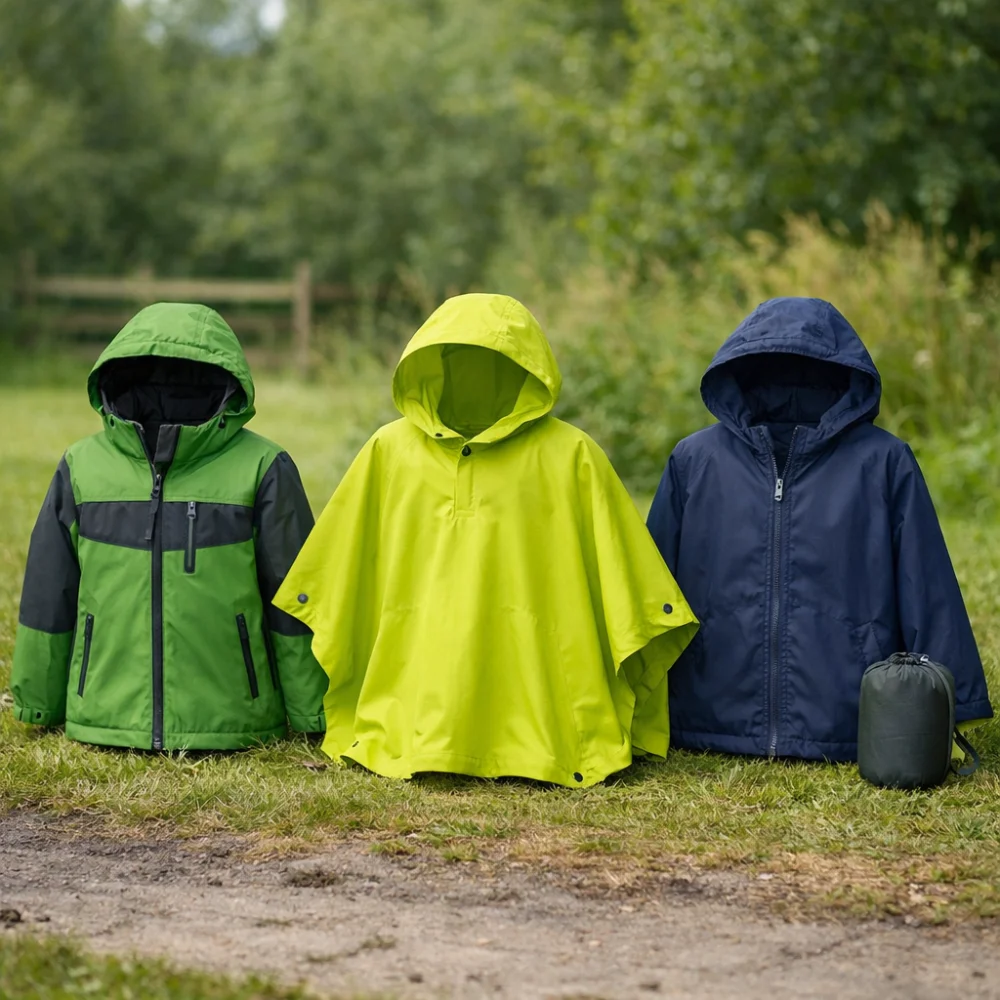
There is often more variation in style than in purpose. The main choice is usually between a shaped rain jacket, a poncho-style option and lighter packable rainwear.
Rain jackets
These usually offer a more familiar coat shape and can be a good all-round choice for school and everyday wear. They may feel more secure than looser styles, but they can take up a little more space.
Ponchos
Poncho-style rainwear can be easy to pull on and may suit situations where fast coverage matters. The trade-off is that they can feel less tailored and may not be as tidy for regular everyday wear.
Packable styles
These are useful if the coat is mainly a backup for sudden showers or trips out. They are convenient, but packability may mean a lighter feel and less structure than a dedicated everyday rain jacket.
Which type suits different needs?
| Need | What to prioritise | Why it helps | Possible compromise |
|---|---|---|---|
| School runs | Easy fastening, sensible fit and good hood coverage | Makes daily use simpler and more comfortable | May be less compact to carry |
| Outdoor play | Freedom of movement and comfortable layering | Helps the coat work while running, climbing or cycling | Extra room can reduce the neatest fit |
| Travel or days out | Packability and light weight | Easier to keep in a bag for unexpected rain | May feel less substantial than a regular coat |
| Quick over-clothing protection | Simple on-and-off design | Useful when weather changes quickly | Less tailored fit may be less comfortable for long wear |
Common mistakes to avoid
- Choosing only by age label. Fit can vary, so the size guide and garment shape matter more than the age number alone.
- Ignoring what the coat will go over. A raincoat that works over a T-shirt may feel too tight over a jumper or uniform.
- Overlooking the hood. Poor hood shape can make an otherwise decent coat frustrating to wear.
- Assuming packable means durable. A compact coat can be very useful, but it may not suit every type of everyday use.
- Forgetting who will help the child dress. A fastening that suits older children may be awkward for younger ones.
Safety and suitability caveats
Children’s raincoats should be chosen for the activity and the weather, not just the appearance. Check whether the style gives enough freedom to move, whether the hood stays usable without blocking vision and whether the fit works over normal clothing. For younger children, comfort and ease of use are often just as important as coverage.
It is also sensible to look at how visible the coat is in dull conditions if that matters for your use. A raincoat is only one part of weather-ready clothing, so think about the rest of the outfit as well.
Maintenance, storage and lifespan considerations
A children’s raincoat is usually easier to live with if it is simple to clean and dry. Wet outerwear needs somewhere practical to hang after use, and a coat that dries quickly is often more convenient for school weeks and regular outdoor play.
When comparing options, think about whether the child will need the coat for occasional showers or repeated use through a season. Frequent wear may make comfort, easy care and dependable fastening more important than a highly specialised design.
How to compare options efficiently
- Decide when the coat will be used most often, such as school, play or travel.
- Pick the style that suits that routine, whether jacket, poncho or packable rainwear.
- Check fit, hood coverage, fastening and how it layers over clothes.
- Weigh convenience against coverage and comfort.
- Read the individual product page carefully before choosing.
Summary buyer decision checklist
- Will the coat suit the child’s main wet-weather use?
- Does the fit leave room for the clothes it needs to go over?
- Is the hood practical and likely to stay in place?
- Is the fastening simple enough for the child to manage?
- Does the style balance coverage, comfort and portability in the right way?
- Have you checked the individual product page for the details that matter most?
Frequently asked questions
How do I choose the right size in a children’s raincoat?
Start with the size guide and think about what the coat will be worn over. A raincoat that is too snug may limit movement, while one that is too large can be awkward to wear. If the child is between sizes, the better choice often depends on whether you want more room for layers or a neater everyday fit.
Are poncho-style raincoats a good choice for children?
They can be useful when quick, simple coverage matters. They are often easy to put on and take off, which is helpful for travel or sudden rain. The trade-off is that they may feel less secure or less tidy than a more shaped coat.
What matters more: waterproofing or comfort?
Both matter, but the right balance depends on how often the coat will be worn. A child is more likely to wear a coat that feels comfortable, even if it is not the most substantial option available. For regular use, it is worth looking for a sensible compromise rather than focusing on one feature alone.
Should a children’s raincoat be roomy?
It should usually allow for layers without feeling oversized. Too much extra space can make sleeves, hems and hoods harder to manage. The goal is enough room for practical use, not a loose fit for its own sake.
Is a packable raincoat suitable for everyday use?
Sometimes, but that depends on how the child will use it. Packable styles are very handy for bags and trips, yet a more structured coat may be preferable if it will be worn often. Check whether convenience or everyday comfort is the higher priority.
What should I check on the product page before buying?
Focus on size guidance, style, fastening, hood shape and whether the coat looks suitable for the child’s routine. If the product page gives care or use notes, those are worth reading too. For any model-specific detail, rely on the individual listing rather than the category alone.
How to read rain-protection details
Product wording such as “water-resistant” or “waterproof” is only a starting point; it does not tell you how a particular coat performs in every condition. Check the individual product information for any stated level of protection and details about construction, such as the front fastening, cuffs or seams, where these are provided.
Also consider whether the coat is lined. A lining may add warmth but can make a coat feel bulkier, so think about the weather and layers it needs to suit. Do not assume that a raincoat is insulated, or that a lightweight style provides the same warmth as a lined one.
More Children's Raincoats
See all 186 Children's Raincoats →


As an Amazon Associate we earn from qualifying purchases.