

Packable daypacks are a useful choice when you want a lightweight bag that can live inside a larger pack or suitcase until you need it. They suit travellers, walkers, commuters and anyone who wants an extra carry option without committing space to a full-size backpack.
The main decision is not simply whether a packable daypack folds small, but how it balances compact storage with comfort, organisation and durability. Some are designed as emergency extras, while others are better for repeated day use.
Because models vary, it helps to think first about where you will use it, how often you will pack it away and how much structure you need once it is open.
What should you look for in a packable daypack?
The best starting point is the use case: occasional backup, travel companion or regular light daypack. A smaller packed size is useful if it has to disappear into luggage, but a very minimal design may be less comfortable when carried for longer periods. Look for the balance that matches your trip or routine rather than chasing the smallest folded footprint.
| Feature | What It Means | Why It Matters | What To Check |
|---|---|---|---|
| Packed size | How compact the daypack becomes when stowed | Affects how easily it fits into luggage or another bag | Whether it suits the space you have available |
| Carrying comfort | How it feels when worn with contents inside | Important if you expect to use it for more than a short outing | Shoulder strap design, back panel shape and overall structure |
| Organisation | Pockets, compartments and access style | Helps separate essentials and makes items easier to reach | Whether the layout suits your everyday items |
| Durability | How well the bag is likely to cope with repeated packing and use | Useful if the pack will be folded, stuffed and unpacked often | Material feel, stitching and closure quality on the product page |
| Weather resistance | How much protection it may offer from light damp or drizzle | Relevant for day trips and travel use outdoors | Any mention of water resistance or a protective finish |
Key decision criteria
Packed size versus usable comfort
Packable daypacks are meant to save space, but very compact designs often have fewer comfort features. If you only need a spare bag for light loads, that trade-off may be fine. If you expect to carry water, snacks, layers or souvenirs for hours, a bit more structure can matter.
Capacity and real-world load
Capacity is only useful when you think about what you actually carry. A daypack that works for a spare jumper and lunch may feel cramped once you add a camera, bottle and waterproof layer. Check the overall shape as well as the listed capacity, because two packs with similar numbers can feel quite different in use.
Straps and support
Simple shoulder straps can keep weight down, but they may not feel as supportive under a heavier load. If the bag will only be used occasionally, minimal straps may be enough. For repeat use, look for features that spread the weight more comfortably across the shoulders and back.
Organisation and access
Some packable daypacks are essentially a single main compartment, while others add pockets or an external stash space. More organisation can make a bag easier to live with, but it can also add bulk and complexity. Think about whether you prefer simplicity or quick access to smaller items.
Material and durability expectations
Packable bags often use lightweight materials so they stay compact. That is helpful for travel, but it can mean less resistance to rough handling than a more substantial backpack. Specifications vary by model, so always check the individual product page before buying.
Types and variants
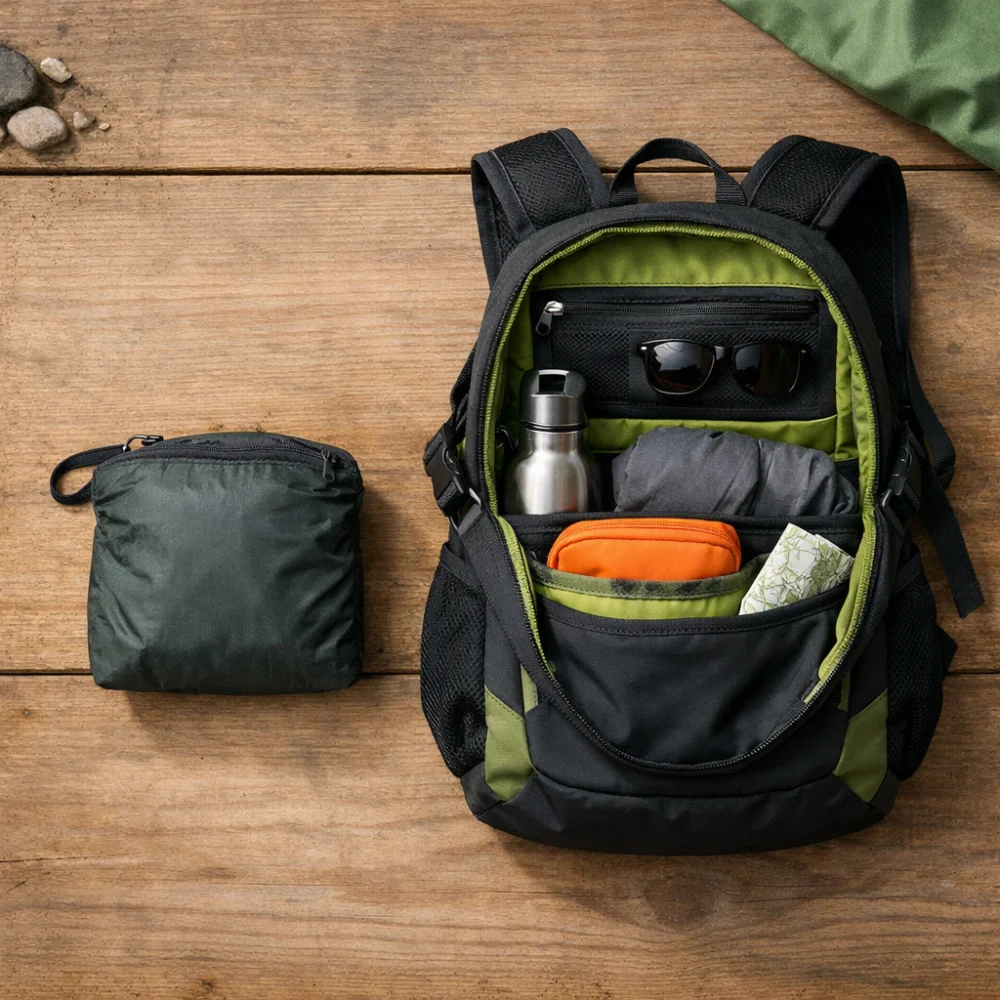
Within this category, the main variation is usually between ultra-compact emergency packs and more structured packable daypacks. The first type is aimed at saving space above all else, while the second gives a more comfortable feel when you actually carry it.
Some buyers prefer a very simple design that folds away neatly into another bag. Others want a packable style that feels closer to an everyday daypack once unfolded. The right choice depends on whether portability or carrying comfort matters more.
Which packable daypack suits which buyer?
| Buyer need | What to prioritise | Why it helps |
|---|---|---|
| Travelling with limited luggage space | Compact packed size and low weight | Makes the bag easy to bring as a spare without taking much room |
| Regular day use | Better straps, a more stable shape and useful organisation | Improves comfort and makes the bag easier to use repeatedly |
| Occasional backup bag | Simple design and easy storage | Keeps the pack unobtrusive until you need it |
| Outdoor day trips | Comfort, secure closures and some weather protection | Helps the bag cope better with changing conditions |
Common mistakes and misunderstandings
- Choosing only by packed size. A very small folded bag is convenient, but it may be less pleasant to carry. Consider the open bag as well as the packed form.
- Assuming all packable bags feel the same. Some are better for short backup use, while others are more suitable for repeated wear.
- Ignoring organisation. A simple main compartment may be fine for some buyers, but others quickly miss a pocket for small essentials.
- Overlooking the load you actually carry. A bag that works for a light layer may not be the right choice for heavier everyday use.
Safety and suitability caveats
Packable daypacks are a convenience item, so the main buying checks are about comfort, durability and fit for purpose rather than specialist safety features. If you plan to use one for outdoor activities, pay attention to the closure style, carrying comfort and any stated weather resistance. Do not assume a compact bag is suitable for every load or every setting.
Care, storage and longevity
These bags are usually chosen for portability, so how you store them matters. Packing them away clean and dry helps avoid odours and wear from trapped moisture. If a model folds into its own pouch or pocket, check that the folding method is practical for you, because a bag that is awkward to repack may end up being used less often.
Repeated stuffing and unfolding can also affect how long a lightweight pack feels neat and comfortable. For that reason, it is sensible to look for straightforward construction and materials that suit the amount of use you expect.
How to compare options efficiently
- Decide whether you need a spare bag, a travel companion or a regular light daypack.
- Compare packed size against the space you have available in luggage or another bag.
- Check comfort, straps and organisation against the load you expect to carry.
- Review material, closures and any weather-related notes for everyday practicality.
- Read the individual product page carefully to confirm the details that matter to you.
Summary buyer decision checklist
- Will the bag be a backup, travel item or regular daypack?
- Is the packed size genuinely small enough for your luggage or storage space?
- Does the open bag look comfortable enough for the loads you plan to carry?
- Is the pocket layout simple enough or organised enough for your needs?
- Does the construction seem suitable for how often you will fold and use it?
- Have you checked any stated weather resistance or care notes?
Frequently asked questions
Are packable daypacks only for travel?
No. Travel is a common use, but packable daypacks can also work as a spare gym bag, an extra commuting bag or a lightweight option for short outings. The main question is whether you want something that disappears easily when not needed.
Are packable daypacks comfortable enough for all-day use?
Some are comfortable enough for longer wear, but others are really designed for occasional light carrying. Comfort depends on the straps, structure and how much you put inside, so it is worth checking the product details carefully.
Should I choose the smallest folded bag possible?
Not necessarily. The smallest folded bag is handy if storage space is tight, but it may be a compromise on support or durability. The better choice is usually the one that fits both your storage needs and your likely carrying load.
Do packable daypacks usually have lots of pockets?
Not always. Many are deliberately simple so they stay light and compact, while others add more organisation. If you carry small items that you want to separate, check the pocket layout before buying.
How do I know if a packable daypack is right for hiking?
Think about the length of the walk, how much you will carry and whether you need more comfort or weather protection. For short, light days out they can be a useful option, but for heavier or more demanding use you may want a more supportive daypack.
What matters most if I want one as a spare bag?
For spare-bag use, compact storage and easy unfolding are usually the priorities. You can usually accept simpler features if the pack is only going to be used occasionally.