

Push golf carts are for golfers who want to move their clubs around the course with less carrying effort while keeping a simple, non-powered setup. They are a practical choice for many players, but the right cart depends on how often you play, how much you value easy folding and how much storage space you have.
Because designs vary, it helps to think about stability, folding size, wheel layout and how your golf bag sits on the frame. A cart that suits one golfer well may feel awkward for another if it is too bulky, too light, or not easy to adjust.
This guide focuses on the buying decisions that matter before you compare individual product pages. Specifications vary by model, so always check the individual product page before buying.
What should you look for in a push golf cart?
The best starting point is to match the cart to your usual round: the terrain you play, the bag you use and how much lifting you want to do. A lighter, more compact cart may be easier to transport, while a more substantial frame can feel steadier on the course. The main trade-off is usually between convenience off the course and confidence when pushing it over uneven ground.
| Feature | What it means | Why it matters | What to check |
|---|---|---|---|
| Folded size | How compact the cart becomes when stowed | Affects car boot storage and ease of carrying to the first tee | Whether it fits your vehicle, locker or home storage space |
| Wheel layout | The number and arrangement of wheels | Influences stability and how smoothly the cart tracks over the ground | How it behaves on slopes, paths and rougher turf |
| Frame weight | How heavy the cart is to lift and handle | Impacts transport, loading and how easy it feels to use repeatedly | Whether you prioritise portability or a more planted feel |
| Bag compatibility | How the cart supports and secures your golf bag | Helps the bag sit securely without wobble or awkward balancing | Whether it suits the style and size of your current bag |
| Adjustment and controls | How the handle, bag supports or brakes are set and used | Can make the cart easier to live with on hills or during setup | How intuitive the folding, unfolding and adjustment steps are |
| Accessories and extras | Added features such as storage or holders | May improve convenience, but can also add bulk or complexity | Which extras you will genuinely use rather than just notice |
Key decision criteria
Folding and storage
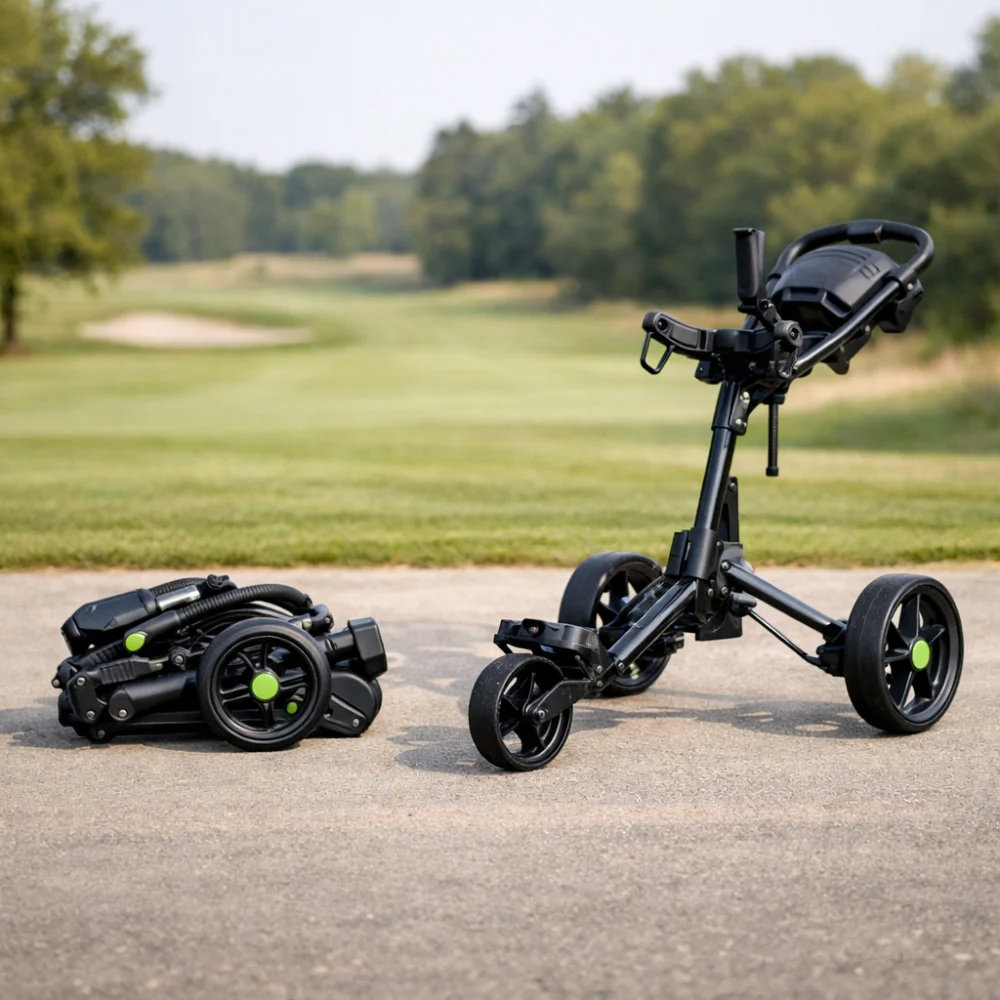
Many buyers judge a cart on the course, but daily convenience often depends on how easily it folds and where it will live between rounds. If you travel with your clubs by car, a compact fold can be more important than a small difference in frame shape. Think about whether you want a cart that disappears neatly into the boot or one that is still manageable but larger.
Weight and handling
Weight affects more than carrying. It can influence how easy the cart is to lift, how stable it feels when loaded and how tiring it is to use over a full round. A lighter cart may be simpler to move, but a slightly heavier one can sometimes feel calmer on uneven ground.
Bag fit and support
Your golf bag is part of the system, so the cart should hold it securely without constant readjustment. Check how the bag is restrained and whether the shape suits your bag style. If you change bags often, a cart with straightforward adjustment may be more forgiving.
Wheels and course conditions
Different wheel setups can change how the cart rolls over paths, grass and mild slopes. The key question is not just whether it moves, but how confidently it moves when the ground is less than perfect. If your usual course has more hills or softer ground, stability becomes more important than absolute compactness.
Ease of use
Simple folding, clear controls and a comfortable handle all reduce friction when you are setting off or packing away. Small convenience differences can matter a lot if you play regularly. Consider whether you prefer a straightforward, minimal cart or one with extra features that may take a little more time to manage.
Types and variants within push golf carts
Within this category, the main differences are usually practical rather than dramatic. Some carts prioritise compact folding and light handling, while others emphasise a steadier stance and more course-friendly control. There may also be differences in how minimal or feature-rich the design feels.
A simpler cart can suit golfers who want low fuss and easy storage. A more fully featured cart may suit those who value extra convenience on the course, but added features can increase bulk and complexity. The right choice depends on whether transport ease or on-course convenience matters more to you.
Which push golf cart suits which buyer?
| Buyer need | Features to prioritise | Why |
|---|---|---|
| Frequent golfer with limited boot space | Compact folding, simple setup | Makes transport and storage easier between rounds |
| Golfer on hilly or varied courses | Stable frame, predictable wheel behaviour | Helps the cart feel controlled over changing ground |
| Buyer replacing a worn cart | Bag fit, folding method, handling feel | Helps avoid ending up with the same frustrations as before |
| Occasional golfer | Ease of use, straightforward design | Reduces the effort of setup when the cart is not used every week |
| Gift buyer | General compatibility and simple operation | Makes it easier to choose a practical, broadly useful option |
Common mistakes and misunderstandings
- Choosing on appearance alone. A neat-looking cart is not always the easiest to fold, store or push.
- Ignoring the bag you already own. The cart should suit the bag shape and how it balances when loaded.
- Overvaluing extra features. Add-ons can be useful, but only if they match the way you actually play.
- Forgetting transport and storage. A cart that is awkward to lift into a car can become a nuisance very quickly.
- Assuming all push carts feel the same. Small differences in frame layout, folding mechanism and wheel arrangement can change the experience a lot.
Safety and suitability caveats
Check that the cart is intended for the way you plan to use it and that its layout works with your bag and typical courses. If you play on steep or uneven ground, look carefully at stability-related details on the product page. It is sensible to treat any extra features as convenience items rather than essential guarantees of performance.
Maintenance, storage and lifespan considerations
Push golf carts usually need straightforward care, but buying decisions should still factor in cleaning, drying and storage. A cart that folds neatly may be easier to keep in good condition because it is simpler to pack away after a round. If a model has moving parts or adjustment points, think about how easy they will be to keep clean and free from grit.
It is also worth considering how often you want to handle the cart between uses. A design that is easy to fold and store is often more likely to be used regularly and looked after properly.
How to compare options efficiently
- Start with where and how often you play, including storage and transport constraints.
- Check whether the cart suits your existing bag and preferred level of setup effort.
- Compare folded size, weight and wheel layout, since those affect day-to-day convenience most.
- Balance simplicity against extras, and decide which features you will genuinely use.
- Read the individual product page carefully for the exact details before you commit.
Summary buyer decision checklist
- Will it fit your car boot or storage space?
- Does it suit the golf bag you already use?
- Is the folding method simple enough for regular use?
- Does the cart seem stable enough for your usual courses?
- Are the extra features useful, or just adding bulk?
- Have you checked the individual product page for the exact specifications?
Frequently asked questions
Do I need a push golf cart if I already have a golf bag?
Not necessarily, but a cart can make repeated rounds less physically tiring by moving the bag for you. The real question is whether you prefer carrying, pushing or a mix of both depending on the course and weather. If you play regularly, that difference in effort can matter more than it first seems.
What matters more: light weight or stability?
It depends on how you will use the cart. Light weight is helpful if you lift it in and out of a car often, while stability may matter more on uneven ground or sloping paths. Many buyers are trying to balance those two priorities rather than maximise one at all costs.
Will any push golf cart suit any golf bag?
Not always. Bag shape, size and how the cart supports the bag can affect how securely everything sits together. It is wise to check the product page carefully and make sure the cart is a sensible match for the bag you already own.
Are extra features worth paying attention to?
They can be, but only if they improve the way you actually play. Storage trays, holders or other add-ons may be handy, yet they can also add weight or make the cart more complex. Focus on the features you would use every round rather than the ones that merely sound convenient.
What is the most common buying mistake?
One common mistake is overlooking folding size and storage. A cart that works well on the course can still be frustrating if it is awkward to pack away or does not fit the space you have at home or in the car. Convenience between rounds is a big part of long-term satisfaction.
Should occasional golfers choose a simple model?
Often, yes, because ease of use matters more when you are not handling the cart all the time. A straightforward design can be less fiddly to set up and put away. If you only play now and then, simplicity may be more valuable than extra features.