


A beach umbrella can provide a shaded spot for a beach visit, but the right choice depends on how you plan to use it and where it will be supported. Some designs stand independently, while others attach to a chair; size, adjustment and carrying needs also differ.
This guide explains the main buying considerations and trade-offs. Check the individual product information before deciding, since a similar-looking umbrella may have a different setup or intended use.
Compare Beach Umbrellas


As an Amazon Associate we earn from qualifying purchases.
What should you look for in a beach umbrella?
Start with where the umbrella will be positioned and how it will be supported. Then consider the shade area, adjustability and how you will carry and store it. A larger canopy may cover more space but can be less convenient to transport, while a compact or chair-mounted design may suit a smaller setup but offer less flexibility in placement.
Compare the main buying factors
| Feature | What it means | Why it matters | What to check |
|---|---|---|---|
| Support and attachment | Whether the umbrella is freestanding or designed to attach to a chair or another support. | Determines where it can be used and whether it suits your existing beach setup. | Check the stated mounting method and any compatibility details for your chair or support. |
| Canopy coverage | The area shaded by the canopy. | Affects how much room there is for people or belongings beneath it. | Look for the listed dimensions and consider the space you need to cover. |
| Adjustment | Whether the angle or position can be changed. | Adjustability may help you reposition shade as conditions or seating position change. | Check which adjustments are described and how they relate to the umbrella’s setup. |
| Anchoring and stability | How the umbrella is intended to be supported on the ground or attached to another object. | The support method affects suitability for the place and surface where you plan to use it. | Check what support is included or required and the maker’s guidance for intended conditions. |
| Portability and storage | How the umbrella is carried and stored when not in use. | Important if you have a long walk to the beach or limited space at home. | Compare listed packed dimensions, weight and any included carry case where specified. |
Choosing the right features
Support method and compatibility
Freestanding umbrellas and chair-mounted designs solve different setup problems. A freestanding style gives you more choice about where to place the shade, provided its support method suits the surface. A clamp-on design may be convenient when you want shade close to a chair, but it is only a sensible choice if the clamp is intended to fit that chair. Do not assume that a clamp will fit every frame.
Some products describe a ground anchor or sand anchor, while others rely on a different support arrangement. Check the product details rather than assuming an anchor is included or suitable for every surface.
Canopy size and shade position
Think about whether you want shade mainly over one seat or a larger area. Compare the canopy dimensions with the space you expect to use, allowing for the fact that the shade’s position changes with the sun. A bigger canopy can be useful for covering more space, but it may take up more room when carried or stored.
Some umbrellas offer a tilting or adjustable canopy. This may help with repositioning shade, but check what adjustment the particular design provides and whether it suits the way you intend to set up.
Portability and packed size
Consider the whole journey: carrying the umbrella from your vehicle or accommodation, moving it across the beach and storing it between trips. A carry bag, if included, may make it easier to handle, but it does not by itself tell you how compact or light the umbrella is. Specifications vary by model, so always check the individual product page before buying.
Types of beach umbrella
Freestanding umbrellas are intended to be positioned separately from a chair. They may suit buyers who want to choose where the shade sits, but require a suitable support method and space for the canopy.
Chair-mounted umbrellas attach to a chair using a clamp or similar fitting. They can keep shade close to the seat, though compatibility with the chair and the range of positioning are important checks.
Adjustable or tilting umbrellas allow some change in canopy angle or position, depending on the design. This can offer more flexibility, but the listed adjustment should be checked rather than inferred from the product title.
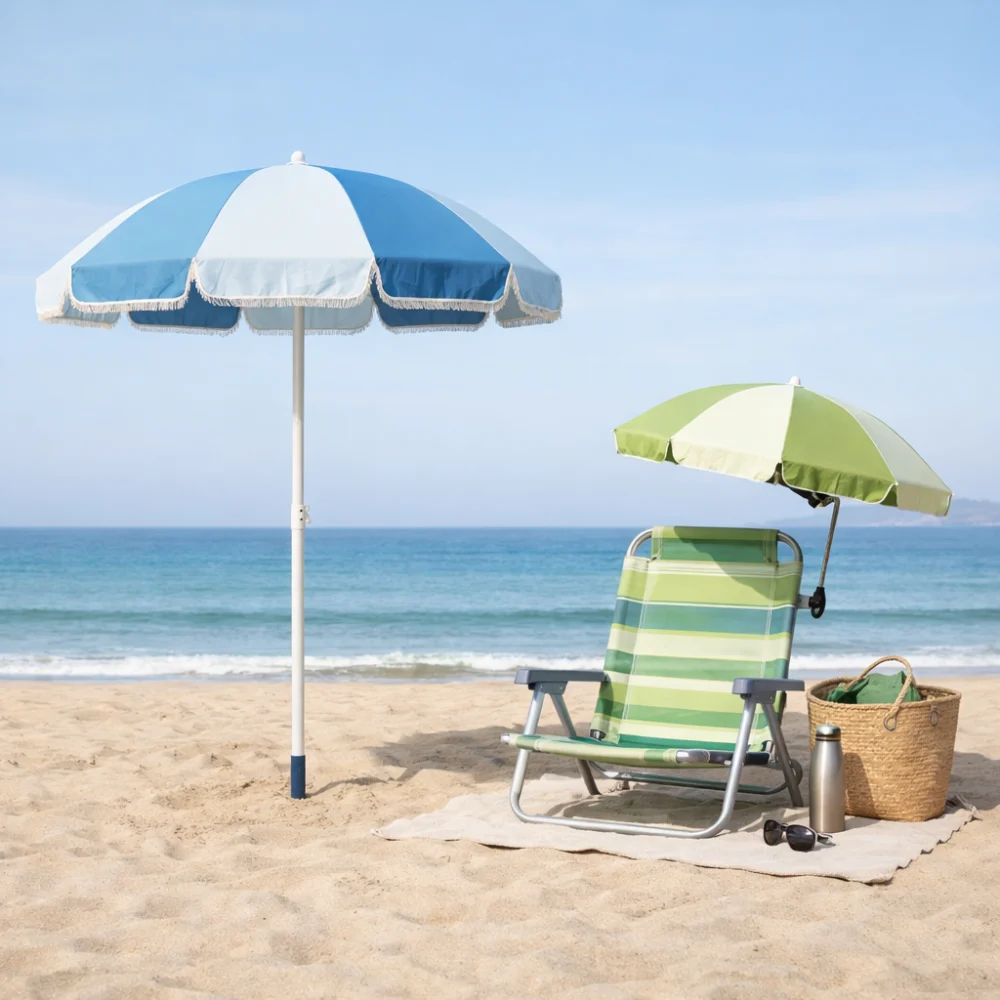
Which style may suit your beach plans?
- For shade beside a beach chair: consider a chair-mounted design if its clamp or attachment is compatible with your chair. A separate umbrella may be preferable if you want to position shade independently.
- For more than one person or belongings: compare canopy dimensions with the area you want shaded. Do not rely on a general description alone to judge usable coverage.
- For a walk to the beach: give extra weight to packed size, weight and the carrying arrangement, where those details are provided.
- For changing shade direction: look for a clearly described tilt or adjustment feature and consider whether it works with the intended support setup.
Common buying mistakes
- Assuming every umbrella fits every chair: check the attachment type and any stated compatibility details before choosing a chair-mounted option.
- Choosing by canopy size alone: a larger canopy may cover more space, but support, portability and storage also affect whether it suits your plans.
- Assuming an anchor is included: check the product details for what is supplied and what support method is expected.
- Expecting an umbrella to remain suitable in any weather: beach conditions can change. Check the maker’s guidance and do not assume a design is suitable for windy conditions.
- Reading a product title as a full specification: confirm dimensions, adjustment, attachment and included items on the individual product page.
Safety and suitability
Choose an umbrella for its stated intended use and follow the manufacturer’s guidance for support and conditions. Beach umbrellas can be affected by wind; do not assume that an anchor or larger canopy makes a design suitable in stronger winds. If conditions change, use your judgement about whether the umbrella remains appropriate.
An umbrella provides shade, but the degree of sun protection can vary by product and conditions. Check any specific protection information supplied for the individual product, and do not assume that shade alone provides complete protection.
Care, maintenance and storage
Check the product information for any care instructions, especially for cleaning and drying before storage. Allowing an umbrella to be stored damp may not suit its materials, so follow the maker’s guidance. Consider packed dimensions and where you will keep it when not in use; included bags and care requirements vary between products.
A practical buying process
- Decide where you want the shade: beside a chair, attached to a chair or positioned independently.
- Choose the support style that suits your setup, and confirm compatibility where an attachment is involved.
- Estimate the area you want shaded, then compare it with the listed canopy dimensions.
- Balance adjustability and coverage against carrying, packed size and storage needs.
- Check the individual product information for support requirements, included items, care guidance and any stated use limitations.
Beach umbrella buyer checklist
- Does the support or attachment method suit your planned setup?
- Are the canopy dimensions suitable for the area you want shaded?
- Is the umbrella compatible with your chair, if it is chair-mounted?
- Are adjustment features clearly described and useful for your needs?
- Can you carry and store it comfortably, based on the listed information?
- Have you checked the manufacturer’s guidance for support, conditions and care?
Frequently asked questions
Are beach umbrellas and beach canopies the same type of product?
They are related shade options, but their designs and setup can differ. Choose according to the space you want covered and how you want the shade supported.
Can I attach a beach umbrella to any chair?
No. Chair-mounted designs depend on their attachment and the chair they are intended to fit. Check the individual product details and any stated compatibility information.
Is a larger beach umbrella always better?
Not necessarily. A larger canopy may shade more space, but can be less convenient to carry and store. Consider coverage alongside support, portability and your planned setup.
Do all beach umbrellas include an anchor?
No. Support arrangements and included items vary. Check the product information to see whether an anchor is included, required or described as a separate component.
Can I use a beach umbrella in windy conditions?
Suitability depends on the specific design and conditions. Follow the manufacturer’s guidance and do not assume an umbrella is suitable in stronger winds simply because it has an anchor.
What should I check before storing a beach umbrella?
Follow the maker’s care guidance, including any instructions about cleaning or drying. Also check the packed dimensions and storage requirements for the particular design.
More Beach Umbrellas
See all 30 Beach Umbrellas →


As an Amazon Associate we earn from qualifying purchases.