

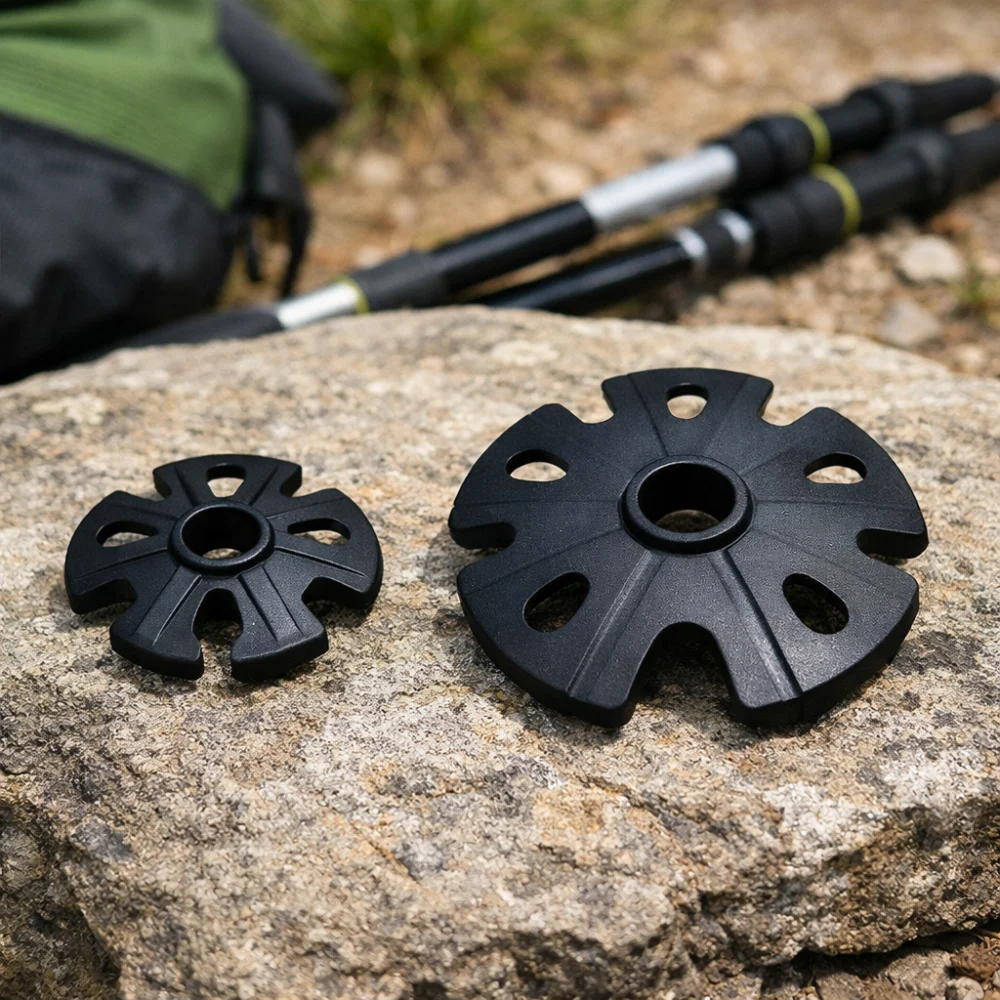
Trekking pole baskets are the small discs that sit near the tip of a pole. They help reduce how far the tip sinks into softer ground and can add a little stability in mud, snow or loose terrain.
If you are replacing a worn basket or choosing baskets for different ground conditions, the main job is to match the basket to the way you walk. The details matter more than the headline description because fit, terrain and pole design can vary by model.
For many buyers, the choice is less about performance claims and more about practical compatibility. Specifications vary by model, so always check the individual product page before buying.
What should you look for in trekking pole baskets?
The best starting point is where you will use the poles most often. A small basket may suit firmer paths and mixed walking, while a larger basket is usually chosen when soft ground is a regular part of the route. The trade-off is simple: more surface area can help on softer terrain, but it may feel less tidy or convenient in harder conditions.
| Feature | What It Means | Why It Matters | What To Check |
|---|---|---|---|
| Basket size | The width of the disc around the pole tip | Affects how much the pole sinks into softer ground | Whether the basket suits your usual terrain |
| Fit with the pole tip | How the basket attaches to the pole | Determines whether it will stay secure in use | Compatibility information on the product page |
| Intended terrain | The ground conditions the basket is designed for | Helps you avoid a basket that is too small or too bulky | Whether it is meant for walking paths, mud or snow |
| Replacement or upgrade use | Whether you need a spare part or a different basket style | Useful if you are replacing a lost or worn item | Matching the basket to the existing pole system |
Key decision criteria
Ground conditions
Think first about the terrain you actually walk on. Soft mud, wet grass and snow place different demands on a basket from dry woodland paths or packed gravel. A basket chosen for one setting may be less useful in another, so it is worth being honest about how often you leave firmer ground.
Compatibility
Basket shape and attachment method can differ between pole designs. A basket that looks similar may still not fit your pole properly, so the product information should be checked carefully before you buy. If you are replacing an old part, matching the existing pole system is usually more important than choosing the biggest basket available.
Size and handling
Larger baskets can offer more support on soft ground, but they are not always the easiest choice for every walk. Smaller baskets are often less obtrusive and may be better for mixed-surface use. The right balance depends on whether you value extra support or a lighter, simpler feel.
Ease of replacement
Some buyers want a straightforward spare part they can fit without changing the rest of the pole setup. Others are choosing baskets as part of a broader pole upgrade. In either case, it helps to look for clear compatibility details rather than assuming a basket will fit a similar-looking pole.
Types and variants
Within this category, the main variation is usually basket size and intended use rather than a wide range of unrelated styles. Some baskets are aimed at general walking, while others are better suited to soft or wintry conditions. The important point is not the name on the listing, but whether the design matches the ground you expect to meet.
If you only walk on firm surfaces, a compact basket may be enough. If you regularly use poles on softer trails, a larger basket is often the more relevant option, provided it fits your poles correctly.
Who is each basket style likely to suit?
| Buyer need | What usually matters most | Likely fit |
|---|---|---|
| Mixed-surface walking | Simple handling and low fuss | A more compact basket may be easier to live with |
| Soft ground or muddy routes | More support against sinking | A larger basket may be more suitable |
| Replacement purchase | Compatibility with the existing pole | Matching the pole system is the key check |
| Occasional use | Convenience over specialist features | A general-purpose basket may be enough |
Common mistakes to avoid
- Choosing by size alone instead of checking whether the basket fits your pole.
- Assuming a basket made for one terrain will work equally well everywhere.
- Buying a replacement without confirming how it attaches to the pole tip.
- Overlooking whether you need a spare part for an existing pole or a basket for a new setup.
Safety and suitability caveats
Baskets can help the pole work more effectively on softer ground, but they are not a substitute for careful footing or suitable footwear. If you walk in mixed conditions, be cautious about assuming one basket style will suit every route. The safest approach is to check the intended use and fit carefully, then choose the option that best matches your normal walking conditions.
Maintenance, storage and lifespan considerations
Baskets are small parts, so wear, loosening or loss can matter more than buyers expect. It is worth checking them periodically if you use poles often, especially after rough or muddy outings. Keep spare parts where you store the poles so a replacement is easier to find if one goes missing.
Storage is usually simple, but dirt and grit can make the parts harder to inspect. A quick clean before storage helps you spot wear and check whether anything has shifted.
How to compare options efficiently
- Start with your main terrain: firm paths, mixed routes or softer ground.
- Check whether you need a replacement part or a different basket style.
- Compare basket size and the intended use stated on the product page.
- Confirm compatibility with your trekking pole system before buying.
- Choose the simplest option that suits how you actually walk.
Summary buyer decision checklist
- Does the basket fit your trekking pole tip or pole system?
- Is the basket suited to the ground you walk on most often?
- Are you replacing an existing part or changing to a different style?
- Will the basket size suit your need for support versus convenience?
- Have you checked the individual product page for the relevant compatibility details?
Frequently asked questions
Do I need baskets on every trekking pole?
Not always. Some walkers only need them for certain surfaces, while others prefer to keep them fitted more often. The decision usually depends on where you walk and how much support you want on soft ground.
Are larger baskets always better?
No. Larger baskets can be more helpful in softer conditions, but they may be less convenient on firmer ground. A smaller basket is often easier to live with if your routes are mostly mixed or hard-packed.
Can I use the same baskets for different poles?
Only if the fitting system matches properly. Similar-looking baskets are not always interchangeable, so compatibility should be checked rather than assumed.
What is the main difference between a replacement basket and an upgrade basket?
A replacement basket is usually chosen to match what you already have, while an upgrade may be chosen for different terrain or handling. The important question in both cases is whether the basket suits your poles and your usual walking conditions.
How do I know when a basket needs replacing?
If a basket is worn, loose or missing, it may no longer do its job as intended. Regular checks are sensible if you use your poles often or walk on rough ground.
Should I buy based on brand alone?
Brand can be a useful reference, but fit and intended use matter more. A well-matched basket from the right system is usually more important than choosing one just because the name looks familiar.