

Beach windbreaks are a simple way to make time on the sand more comfortable by helping to shelter a seated area from breezes and give a little privacy. They are usually chosen for family beach trips, picnics and day visits where you want a calmer base without carrying a full shelter.
The right choice depends on how much cover you want, how easy it needs to be to carry and how securely it will stay in place where you plan to use it. Because conditions at the coast can change quickly, it is worth thinking about both convenience and stability before you compare options.
What should I look for in a beach windbreak?
Start with the balance between coverage, portability and stability. A taller or longer windbreak can feel more enclosed, but it may also be less convenient to carry, position and secure. For most buyers, the best starting point is deciding whether the main goal is light wind shelter, extra privacy or defining a family area on the beach.
Specifications vary by model, so always check the individual product page before buying.
| Feature | What it means | Why it matters | What to check |
|---|---|---|---|
| Height and length | The overall size of the sheltered area | Helps determine how much privacy and wind cover you get | Think about how many people or bags you want to shield |
| Panel style | How the windbreak is divided across its sections | Affects flexibility, how it shapes around your space and how easy it is to position | Look at whether the layout suits a straight line or a more enclosed setup |
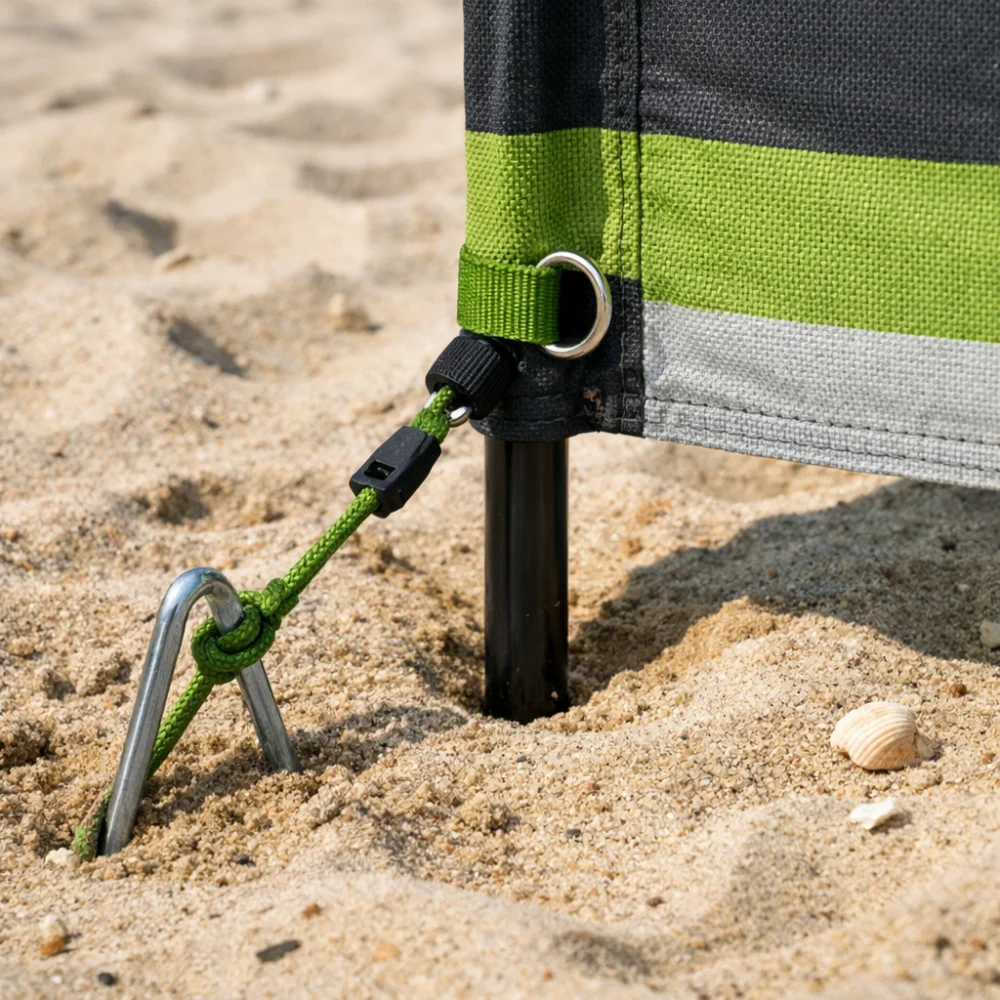
| Ground securing method | How the windbreak is held in place | Important for stability in breezier conditions | Check how it is intended to be fixed in the sand or ground |
| Packability | How compact and easy it is to carry | Useful if you walk far from the car or travel with children and kit | Consider weight, folded size and how it will fit with the rest of your beach gear |
| Material and finish | The general construction and surface treatment | Can affect ease of use, drying time and maintenance | Look for practical details about care and whether it is designed for beach use |
Key decision criteria
Coverage versus convenience
More coverage can mean a better sense of shelter and privacy, but larger windbreaks are not always the easiest to carry or set up. If you usually take short beach trips, convenience may matter more than maximum enclosure. If you stay in one spot for longer, a bigger layout may be worth the extra effort.
Stability in real conditions
At the coast, a windbreak needs to do more than look tall enough. The way it is secured matters just as much as its size, especially on firmer sand or when conditions are breezy. Check how the product is intended to stand in place and whether it suits the ground you usually visit.
Ease of transport
Beach gear is often carried alongside cool bags, toys and towels, so bulk can matter a lot. A windbreak that folds neatly and is easy to handle may be more practical than one that promises more shelter but becomes awkward to bring along.
Privacy and family use
Some buyers mainly want a small enclosed area for changing, feeding children or keeping a picnic space feeling more organised. Others only need a modest barrier to reduce direct breeze. Thinking about the main use helps you avoid paying for features you will not really notice.
Product types and variants
Within this category, the main differences are usually in size, shape and how the sections are arranged. Some options are better for a simple straight wind break, while others lend themselves to making a more enclosed area.
A shorter, lighter design may suit casual outings and people who want minimal kit. A larger or more structured design may suit longer stays, more privacy or families who want a clearer boundary around their space. The trade-off is usually between shelter and portability rather than between obviously different uses.
Which type suits different buyers?
| Buyer need | What to prioritise | Why it helps |
|---|---|---|
| Short beach visits | Simple carrying, quick setup and modest coverage | Makes the windbreak easy to use without adding too much kit |
| Family days out | Practical height, a useful sheltered area and secure fixing | Helps create a more comfortable base for children, bags and picnics |
| Privacy for changing or sitting | Enough height and layout to create a sense of enclosure | Supports more private use without needing a full shelter |
| Frequent beachgoers | Durability, packability and ease of repeated use | Helps the item stay convenient over many trips |
Common mistakes to avoid
- Choosing only by height and forgetting to check how it is secured.
- Assuming a larger windbreak will always be easier to use than a more compact one.
- Overlooking how much space it will take up once it is set out on the beach.
- Buying for privacy when a lighter windbreak would have been enough for your actual use.
- Ignoring packed size if you plan to carry it with other beach equipment.
Safety and suitability caveats
A beach windbreak is a comfort and shelter aid, not a guarantee against strong wind or changing conditions. It should be chosen for the kind of beach, ground and weather you usually expect, and you should check the individual product information for any use limitations. If you often visit exposed spots, stability and secure fixing deserve extra attention.
Care, storage and everyday use
Beach windbreaks are generally easier to live with when they can be dried, folded and stored without hassle after use. Sand, salt and damp can make care more important than it first appears, so a design that is simple to clean and pack away may suit regular use better than one that feels delicate or awkward.
How to compare options efficiently
- Decide whether your main need is wind shelter, privacy or a defined family area.
- Choose the size and layout that matches how much space you actually want to cover.
- Compare the securing method, packed size and ease of carrying.
- Check how the material and construction suit beach conditions and regular transport.
- Read the individual product page carefully before deciding.
Summary buyer decision checklist
- Does the size suit the space you want to shelter?
- Will it be easy enough to carry with the rest of your beach kit?
- Is the securing method suitable for the kind of ground you usually use?
- Does the layout suit privacy, wind shelter or both?
- Will it be practical to dry, clean and store after use?
Frequently asked questions
Are beach windbreaks mainly for wind or privacy?
They can help with both, but the balance varies by design. Some are chosen mainly to reduce breeze around a seated area, while others are used to create a more private corner for changing or family time. Think about which of those matters more before you compare options.
Do I need a large windbreak for a family day at the beach?
Not always. A larger design can be useful if you want more enclosure or space around bags and picnic items, but it can also be less convenient to carry and set up. The right size depends on how much area you want to define and how much kit you are happy to bring.
What matters more than height?
How it is secured and how practical it is to carry often matter just as much as height. A tall windbreak that is awkward to fix in place may be less useful than a slightly smaller one that is easier to position and manage. It helps to compare the whole design, not just one dimension.
Are beach windbreaks easy to use?
Many are straightforward, but ease of use depends on how they are made and how they are intended to stand. If you want a simple beach accessory, look for a design that matches your expected setup routine and is not more complicated than you need.
How do I choose between portability and shelter?
Start with how far you will carry it and how often you will use it. If you walk a long way or travel light, portability may matter more; if you stay in one place for longer, extra shelter may be worth the trade-off. This is often the main decision in the category.
What should I check on the product page before buying?
Check the size, how it is secured, how it packs away and whether the description matches your intended use. Specifications vary by model, so always check the individual product page before buying. That way you can compare the practical details rather than relying on the category name alone.