

Fingerboards are compact training tools used by climbers who want to work on finger strength, grip positions and controlled hangs at home or in a training space. They are not a substitute for climbing practice, but they can support structured training when used thoughtfully.
If you are comparing options for the first time, the main challenge is not finding a board with lots of features, but understanding which features actually suit your current level, space and training goals. A simple board can be more appropriate than a highly complex one.
Because fingerboards are used under bodyweight, it is worth choosing carefully and checking the details on the individual product page before you buy.
Compare Fingerboards


As an Amazon Associate we earn from qualifying purchases.
What should I look for in a fingerboard?
Start with the type of training you want to do most often. The best choice is usually the one that matches your current ability, the space you have available and the kind of grips you want to practise. The main trade-off is between simplicity and variety: a board with more grip options may offer more training flexibility, but a simpler board can be easier to use consistently and assess at a glance.
| Feature | What It Means | Why It Matters | What To Check |
|---|---|---|---|
| Grip variety | The number and style of holds or edges available. | More variety can support broader training, while fewer options may suit a simpler routine. | Look for the grip shapes you actually plan to use rather than a long list of features. |
| Edge depth | How positive or shallow the usable edge feels. | Different depths suit different levels and training aims. | Check whether the board includes edges that match your current ability. |
| Mounting method | How the board is fixed in place. | Secure mounting is important for stability and confidence during use. | Confirm the intended mounting style and whether it suits your wall, frame or training area. |
| Size and layout | The overall dimensions and arrangement of the grips. | This affects how much room the board needs and how comfortable it is to use. | Compare the board size with your available space and preferred training position. |
| Material and finish | The surface feel and construction approach. | This can influence comfort, grip feel and day-to-day use. | Check the product information for the material description and any care notes. |
Key decision criteria
Grip style
Different boards emphasise different grip positions, from larger positive holds to more demanding edges. The important question is whether the board gives you a realistic progression for your current training, not whether it has every possible hold shape. A board that is too demanding may limit useful training, while one that is too easy may stop being helpful as you progress.
Mounting and stability
Fingerboards should feel secure and predictable in use. Think about where the board will go, how it will be fixed and whether the mounting approach suits the structure you have available. Specifications vary by model, so always check the individual product page before buying.
Size, spacing and set-up
Some buyers want a compact board that fits neatly above a doorway or in a small training area, while others prefer a larger layout with more room between holds. The right choice depends on how you plan to train and how much space you can comfortably dedicate to the board. Wider or more complex layouts may offer variety, but they can also need more planning for installation and use.
Comfort and repeat use
Comfort matters because a board that is awkward to use is less likely to become part of a regular routine. Small differences in edge shape, depth and spacing can change how approachable the board feels. If you are comparing several options, focus on the grip types you expect to use most often rather than assuming more features automatically mean a better fit.
Types of fingerboards
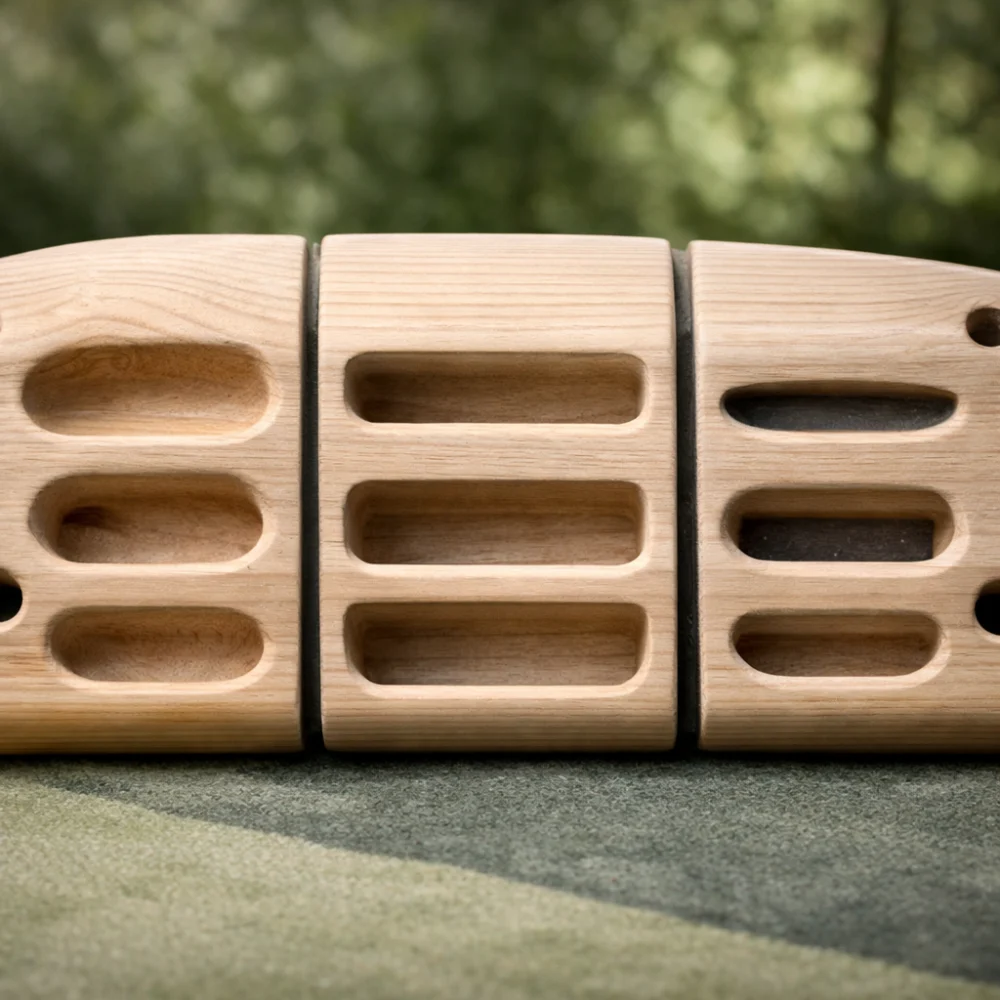
At category level, the most useful distinction is between simpler boards and boards with a broader mix of holds.
- Simpler boards: Often suit beginners or anyone who wants a clear, repeatable setup with fewer decisions to make.
- More varied boards: May suit climbers who want to practise a wider range of grip positions and progress over time.
- More compact boards: Can be easier to place in smaller spaces, though they may offer less training variety.
The right variant depends on whether you want straightforward strength work, more varied training or a board that fits a tighter space.
Which fingerboard suits which buyer?
| Buyer need | Useful characteristic | Why it helps |
|---|---|---|
| Beginner-friendly training | Clear grip layout and simpler choice set | Easy to understand and less overwhelming to start with. |
| Regular home sessions | Stable mounting and comfortable grip mix | Makes repeat use more practical over time. |
| Progression-focused training | Varied edges or grip options | Allows training to stay relevant as ability changes. |
| Limited space | Compact size and suitable fixing method | Helps the board fit the available area without unnecessary bulk. |
Common mistakes and misunderstandings
- Choosing on feature count alone: More grips do not automatically mean a better board. It is usually more useful to match the board to the training you will actually do.
- Ignoring mounting needs: A board can look suitable but still be awkward for your wall or training space. Check how it is meant to be fixed before deciding.
- Overestimating current ability: A board that is too demanding may be frustrating to use. It is often better to choose something that supports progression.
- Forgetting everyday convenience: If setup, space or comfort are poor, the board may not get used regularly. Ease of use matters as much as training potential.
Safety and suitability notes
Fingerboards are training equipment, so suitability depends on the user, the mounting arrangement and how the board is intended to be used. Check the product page carefully for any model-specific guidance, and make sure the board is appropriate for the space and training approach you have in mind. If you are returning to training after time away or have concerns about strain, choose conservatively and progress gradually.
Maintenance, storage and long-term use
Most buyers will want a board that stays clean, feels consistent and remains easy to inspect over time. General care usually comes down to keeping the surface free from excessive dirt or buildup and storing it in a dry place when not in use, if it is not permanently mounted. The exact care needs depend on the material and construction, so check the individual product details where available.
How to compare fingerboards efficiently
- Decide what kind of training you want to do most often.
- Choose a board type that matches your current experience and space.
- Compare grip style, edge depth, size and mounting method.
- Weigh variety against simplicity and everyday convenience.
- Check the individual product page for model-specific details before buying.
Fingerboard buyer checklist
- Does the grip layout suit the training you want to do?
- Is the edge depth appropriate for your current level?
- Will the mounting method work in your space?
- Is the size comfortable for the area you have available?
- Does the board seem practical to use regularly?
- Have you checked the individual product page for model-specific details?
Frequently asked questions
Are fingerboards only for experienced climbers?
No. Some boards are more suitable for experienced users, but simpler options can also suit climbers who want to build strength gradually. The key is to match the board to your current ability and use it in a way that feels controlled.
What matters more: lots of grips or a simple layout?
That depends on how you train. A simple layout may be easier to use consistently, while a broader set of grips can support more varied sessions. Many buyers are better served by a board that they will actually use regularly than by one that looks more advanced on paper.
How important is mounting method?
Very important, because the board needs to suit the space where it will be used. Even a good board is only a good choice if the mounting approach fits your wall or frame and feels secure in the intended location.
Can a fingerboard fit in a small home space?
Often yes, but you need to check the size and fixing method carefully. Compact boards can be practical for smaller spaces, though they may offer less variation than larger designs.
Should I choose the hardest board I can find?
Usually not. A board that is too demanding can limit useful training and reduce confidence. It is generally better to choose something that leaves room for progression rather than starting at the most difficult end.
How do I compare different boards quickly?
Focus on four points: grip style, edge depth, size and mounting method. Those are the factors most likely to affect whether the board suits your training habits and your space.
More Fingerboards
See all 90 Fingerboards →


As an Amazon Associate we earn from qualifying purchases.